- Sun 26 July 2026
- Event Report
- #gaming, #tournament
Mystery tournament contenders select the first of their 2-3 games. Video credit: @CaptainNoFun_G on Twitter. Used with permission.
I've attended The Beast In The East, a gathering of competitive rhythm game and fighting game players, since their second event in 2017, which was held in a vacant lot in Military Circle Mall in Norfolk, VA, on the border of my home town of Virginia Beach. They have steadily grown over the years and in 2019, it was large enough to warrant moving to the Hampton Roads Convention Center in Hampton, VA, about 45 minutes away. I contributed to their proceedings by bringing my own gaming setups for other attendees to play on freely throughout the weekend. I've also held some mystery tournaments there, though The Beast In The East 9 was the first event I was able to do so with official backing. Official support for community-run tournaments was significantly expanded this year, with a dedicated communication channel for community tournament organizers and a start.gg page for the community events. The organizers also supported each other, and I was able to borrow a second portable monitor so the game instructions can be shown on either side of the TV, close to both players. I would like to thank everyone involved with the community tournaments for making this tournament possible.
Upgrading the Setup
In preparation for The Beast In The East 9, and for any future events after, I took it upon myself to expand my controller in every way I could think of, over two months starting in May 2026. After the previous tournament at the DC Riichi Mahjong Open in Arlington, VA, I felt a need to expand my own influence myself, after considering how much of my own time and money I've invested making the mystery tournament experience as polished and smooth for the players as I possibly can. I implemented every feature I could think of to shorten the time between sitting down and playing a game, on top of making it more visibly appealing for passersby with a copious amount of colored lights. I've dubbed the renewed system as Lutero, which refers to the scripts that launch the batch files that prepare the games. Upgrades include RGB-lighted buttons that match the instruction sheet and a large, glowing red button as an alternative to the NFC cards. I had an ESP8266 microcontroller lying in my parts bin for years and a number of spare WS2812 RGB LED "NeoPixel" modules from a previous project, and I finally found a use for them in the IMB2 dual arcade controller. The buttons lighting up in response to the game being launched is inspired by GP2040-CE's RGB LED features, but is implemented externally with a separate microcontroller that drives 32 NeoPixels, two for each button. The PC communicates to the microcontroller on each game launch, which lights up the chain of lights accordingly. I bought transparent buttons during a clearance sale at Focus Attack to use with my RGB lights, and after installing everything, the effect immediately looked even better than I imagined. It's rare that an idea of mine at this scale turns out so well on the first try.
The big red button originally launched a randomly selected game immediately, as if a card was inserted into the reader. In June, I developed an interactive menu in Godot that launches the games, acting as a catalog of the available games. This method replaces the purely random, non-interactive function of the red button. I did need to update my batch scripts to account for quirks in the way Godot launches external processes. The menu is much more accessible and eliminates the risk of the cards being mishandled or lost, however I feared that showing all of the games and letting players choose will lead to only games familiar to them being played, at the expense of my original goal of giving incentive to explore new games. Going by the program logs, that is exactly what happened in The Beast In The East. I prepared nearly 400 games for the sake of completion—I would think it strange as a player for only a few King of Fighters games to be installed, for example—and the majority were never played outside of the tournament. To help combat this, I added the Random button that highlights a random game in the list. It attempts to pick a game that has not been chosen in the last 100 launches, to encourage players to discover new games. It does not immediately launch the game, however, though I considered doing so to recreate the original random button function.
At the Venue
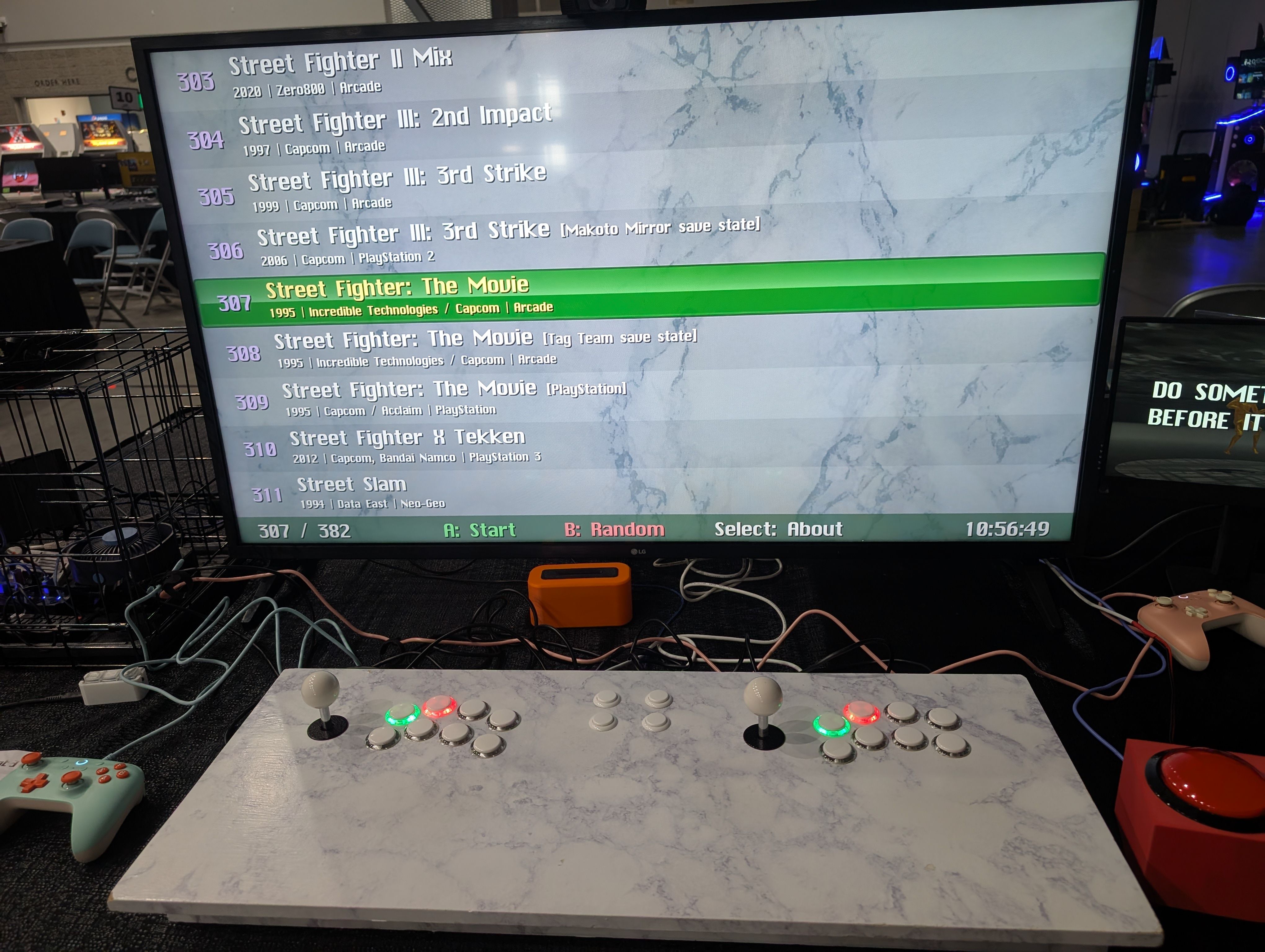
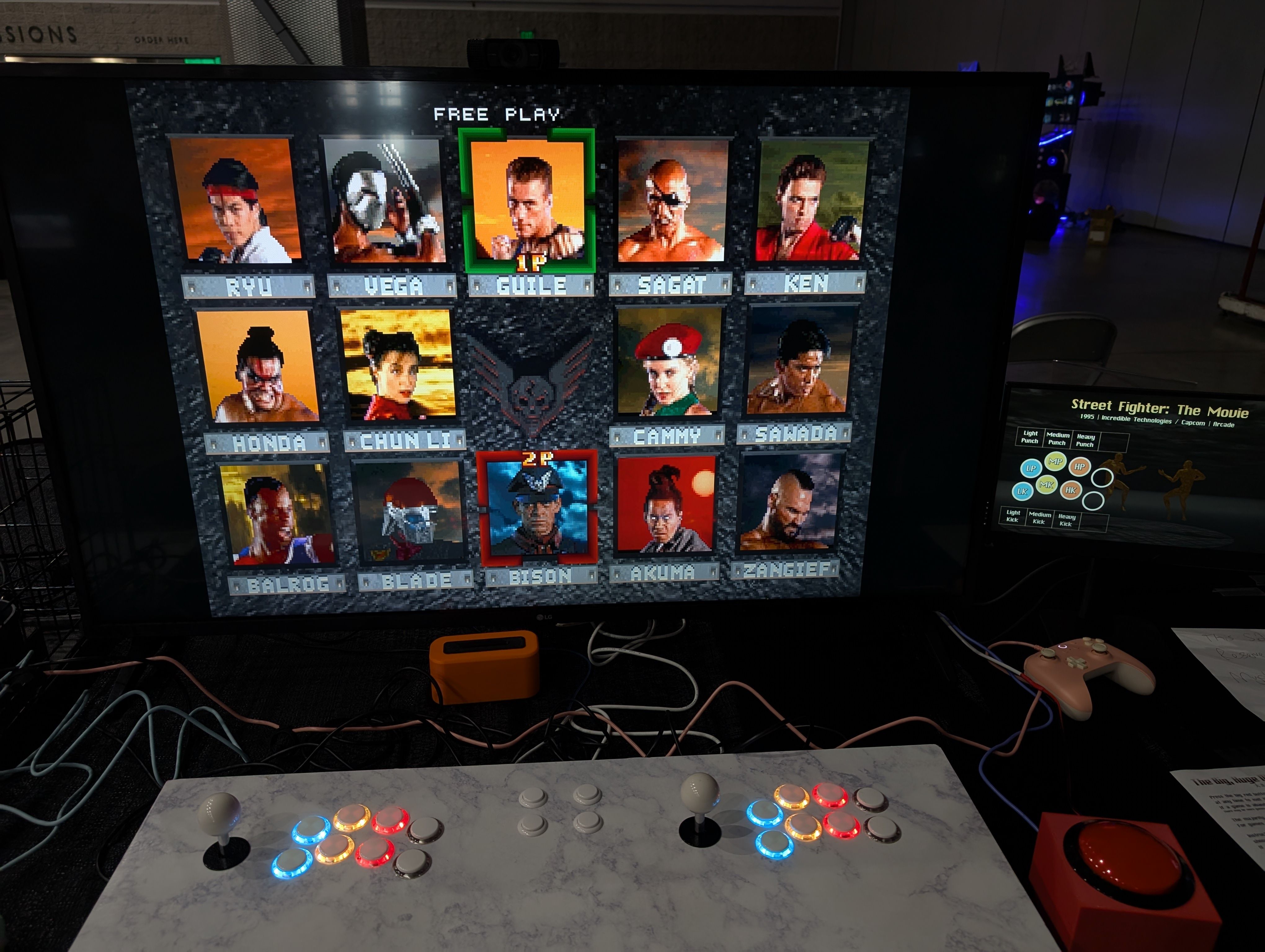
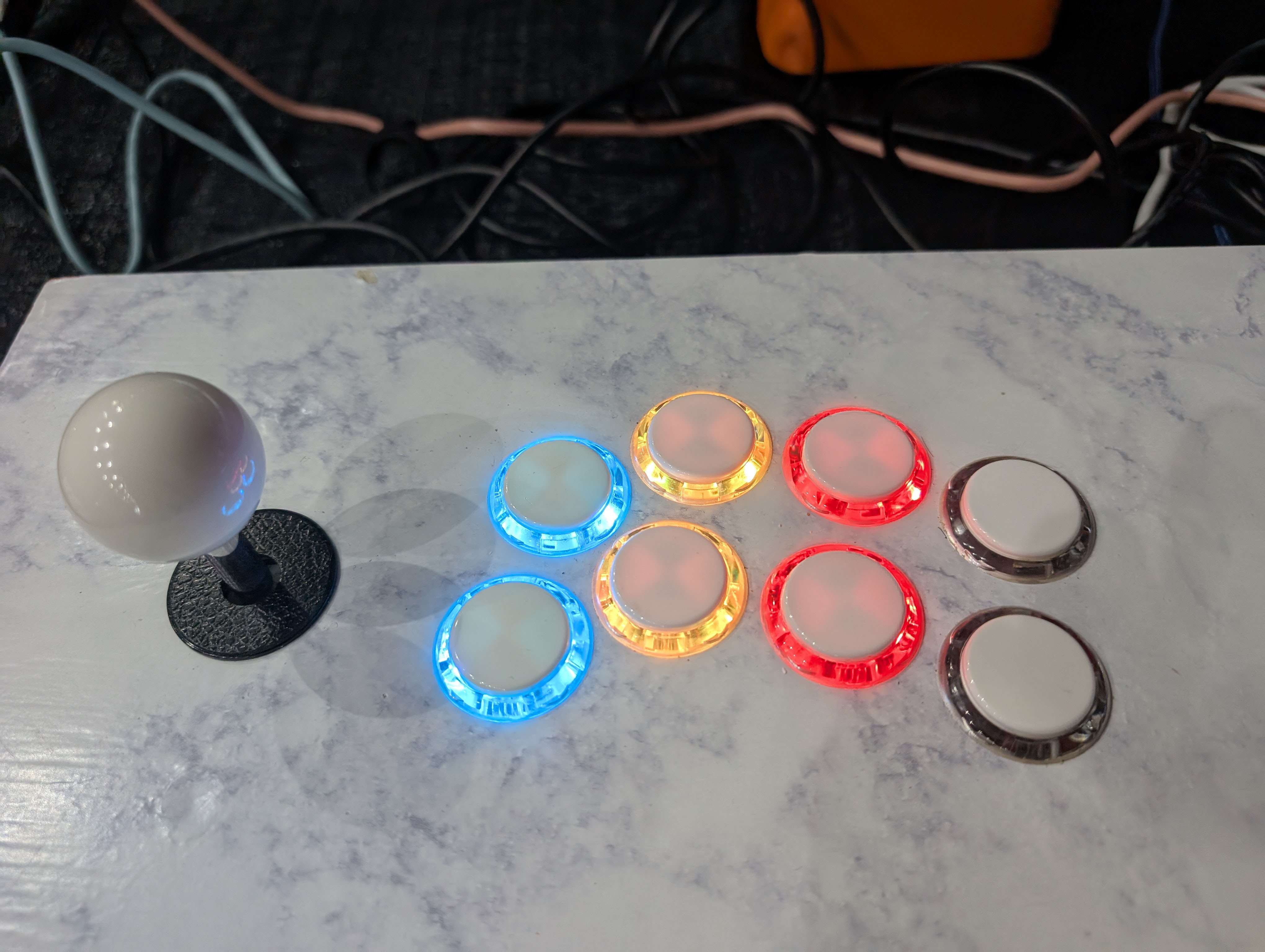
As a community tournament organizer, I was allowed early entry to the convention floor to install my setup in a dedicated table in the middle of the hall. I took these photos before general admission opened to showcase the menu and the RGB buttons. I own one portable monitor for the instructions, which means the player opposite it will need to lean further than the player seated next to it. For the tournament proper, I was able to borrow a spare monitor of the same size from another community organizer that owned several of them. I am considering buying another monitor like it solely for the redundancy for events of this size.
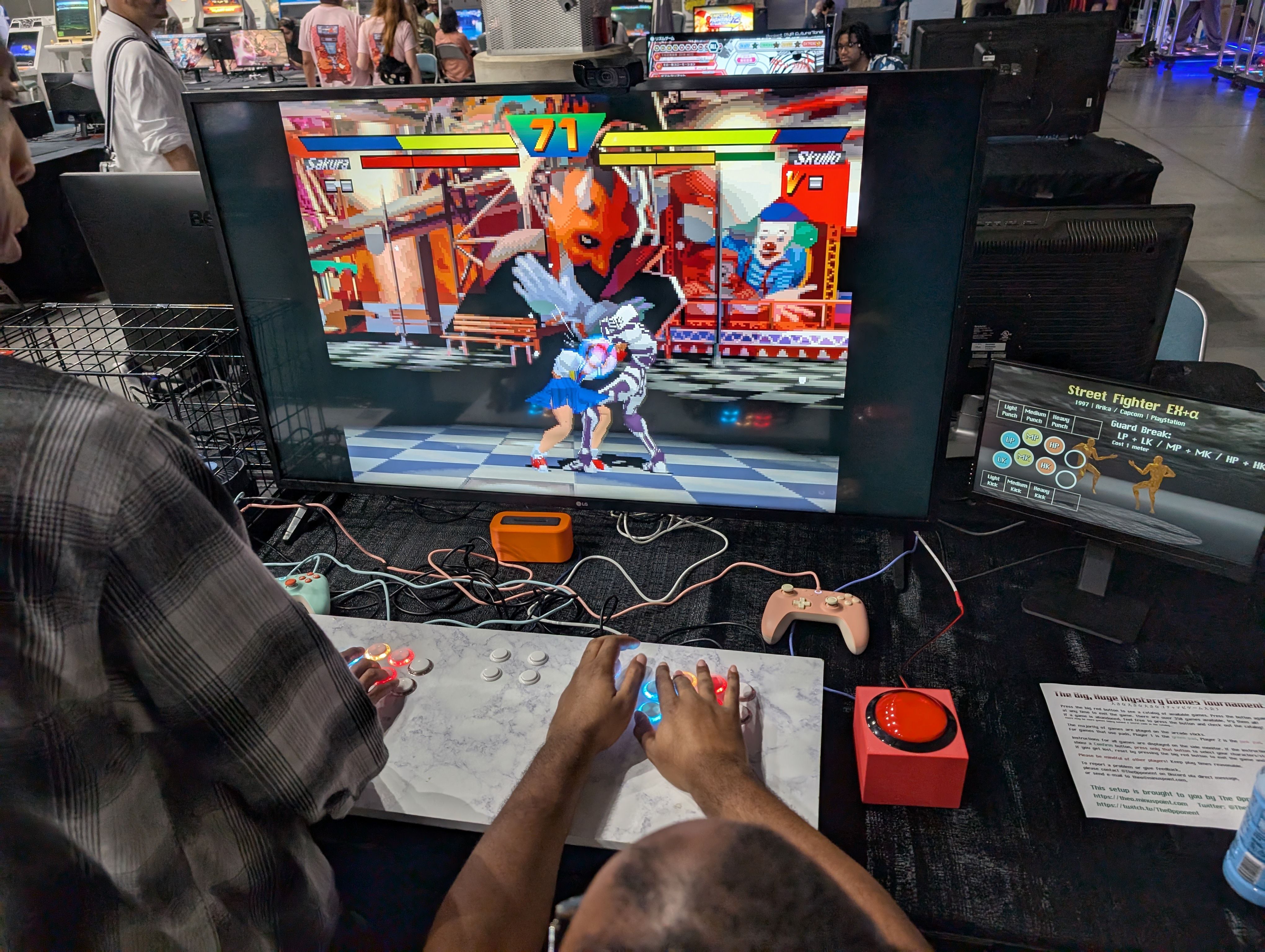
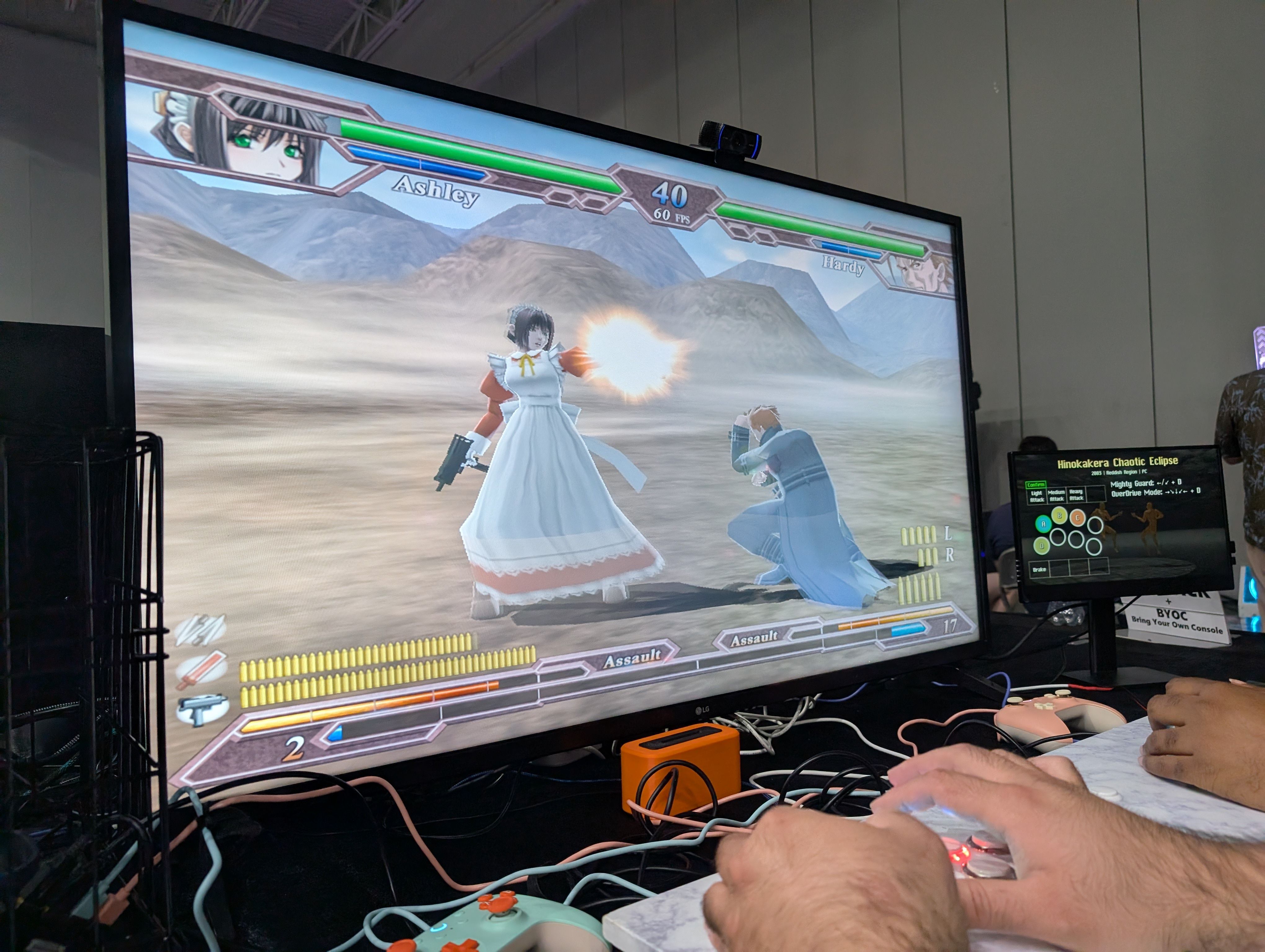
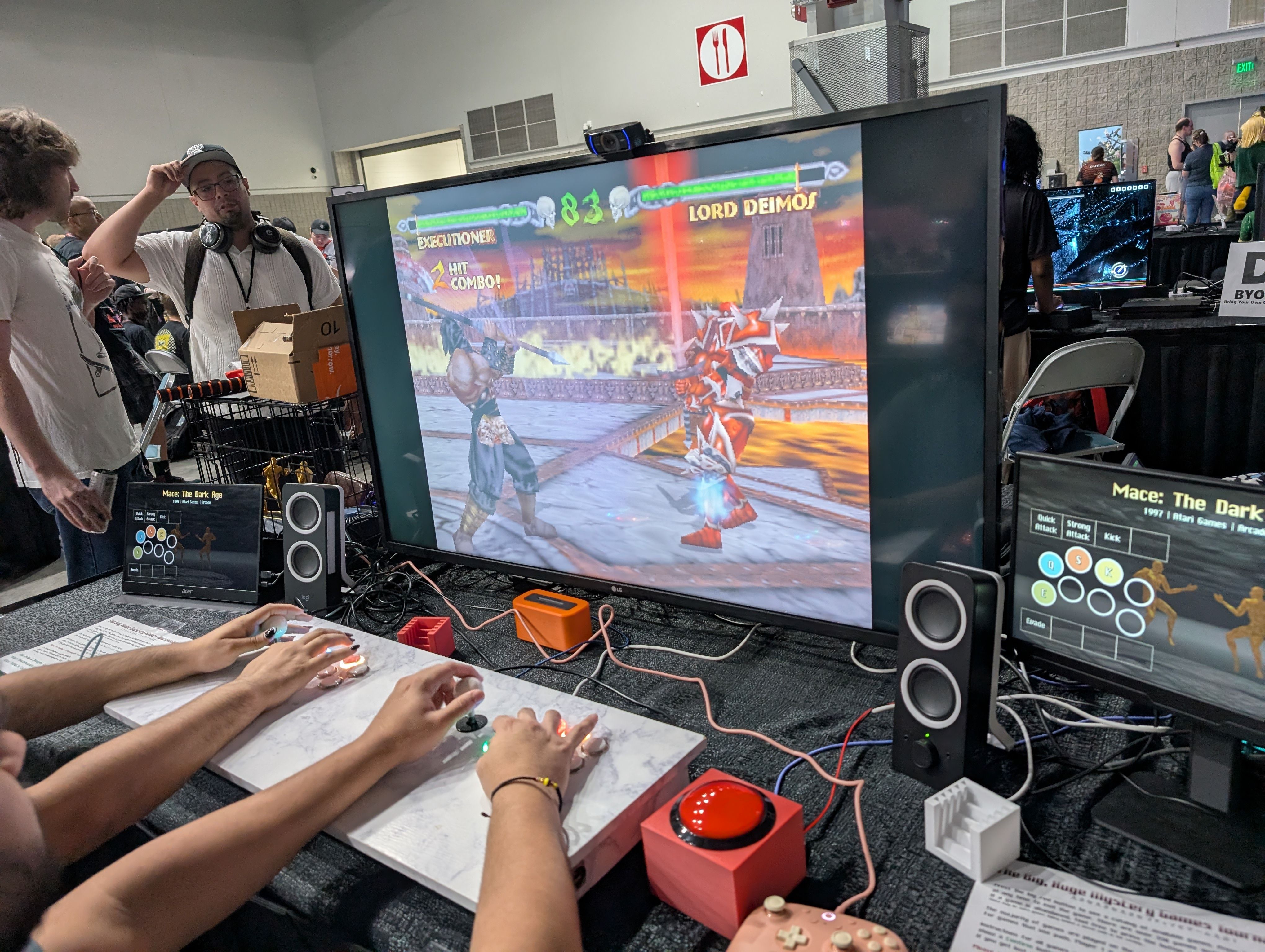
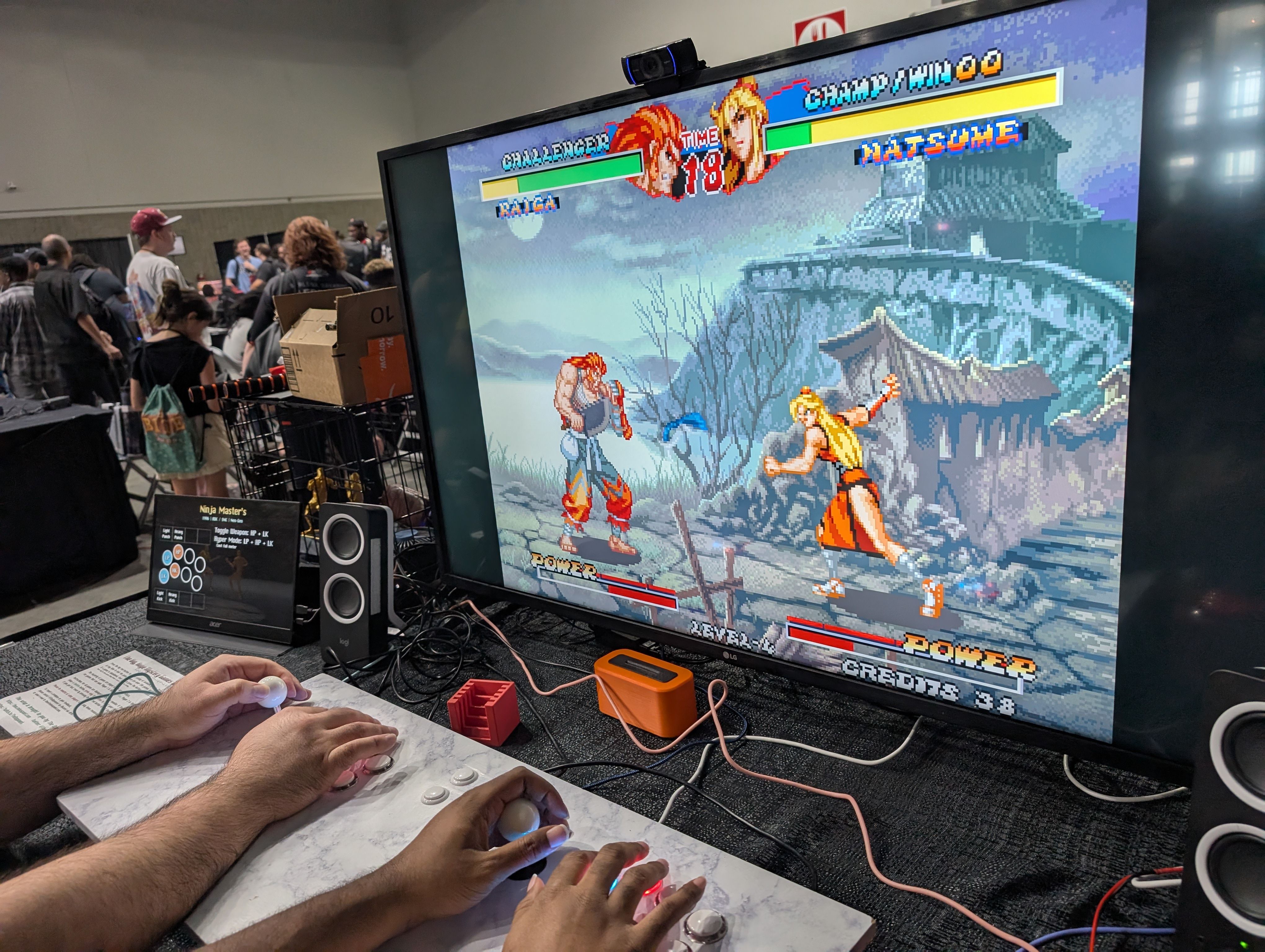
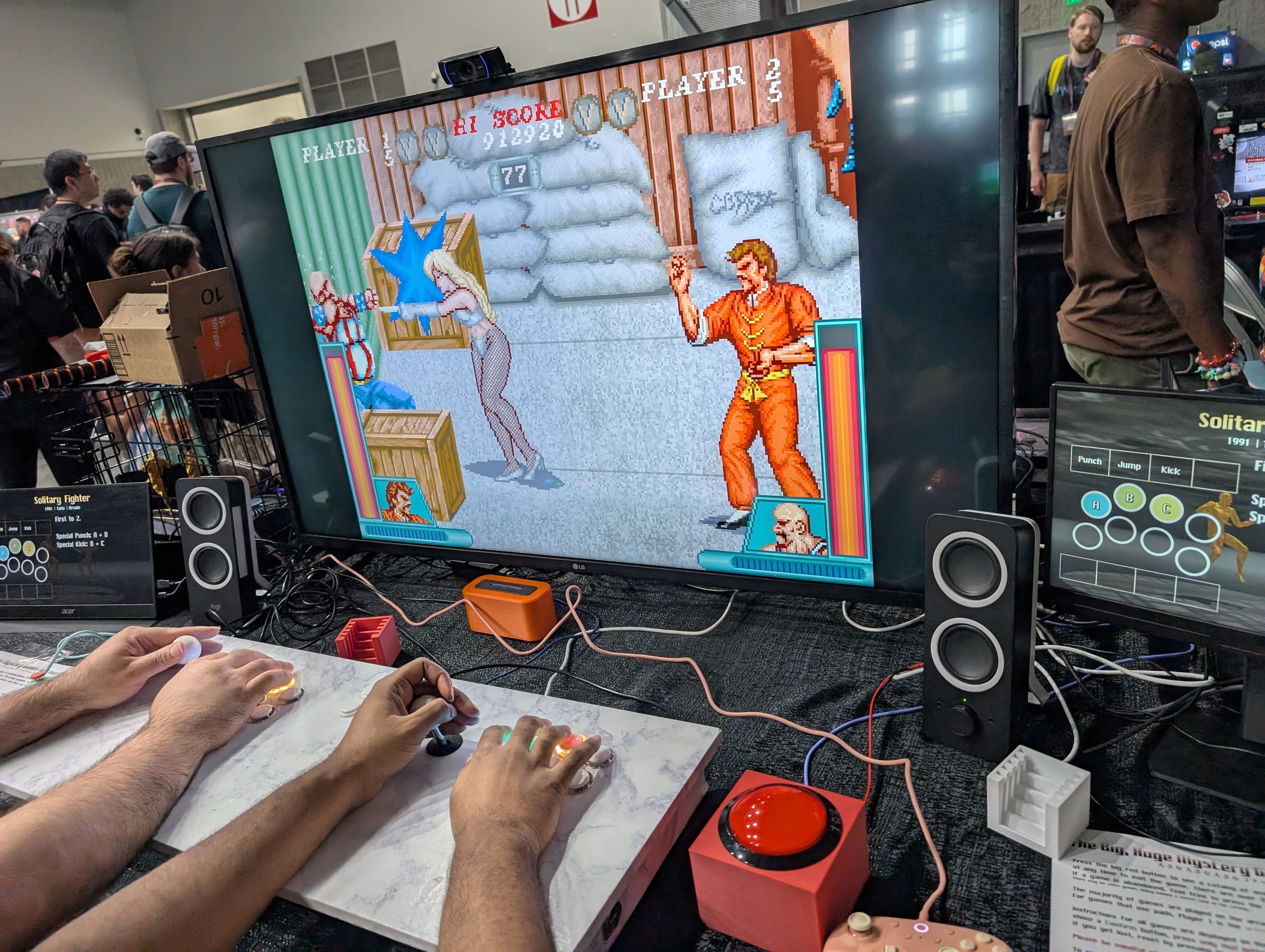
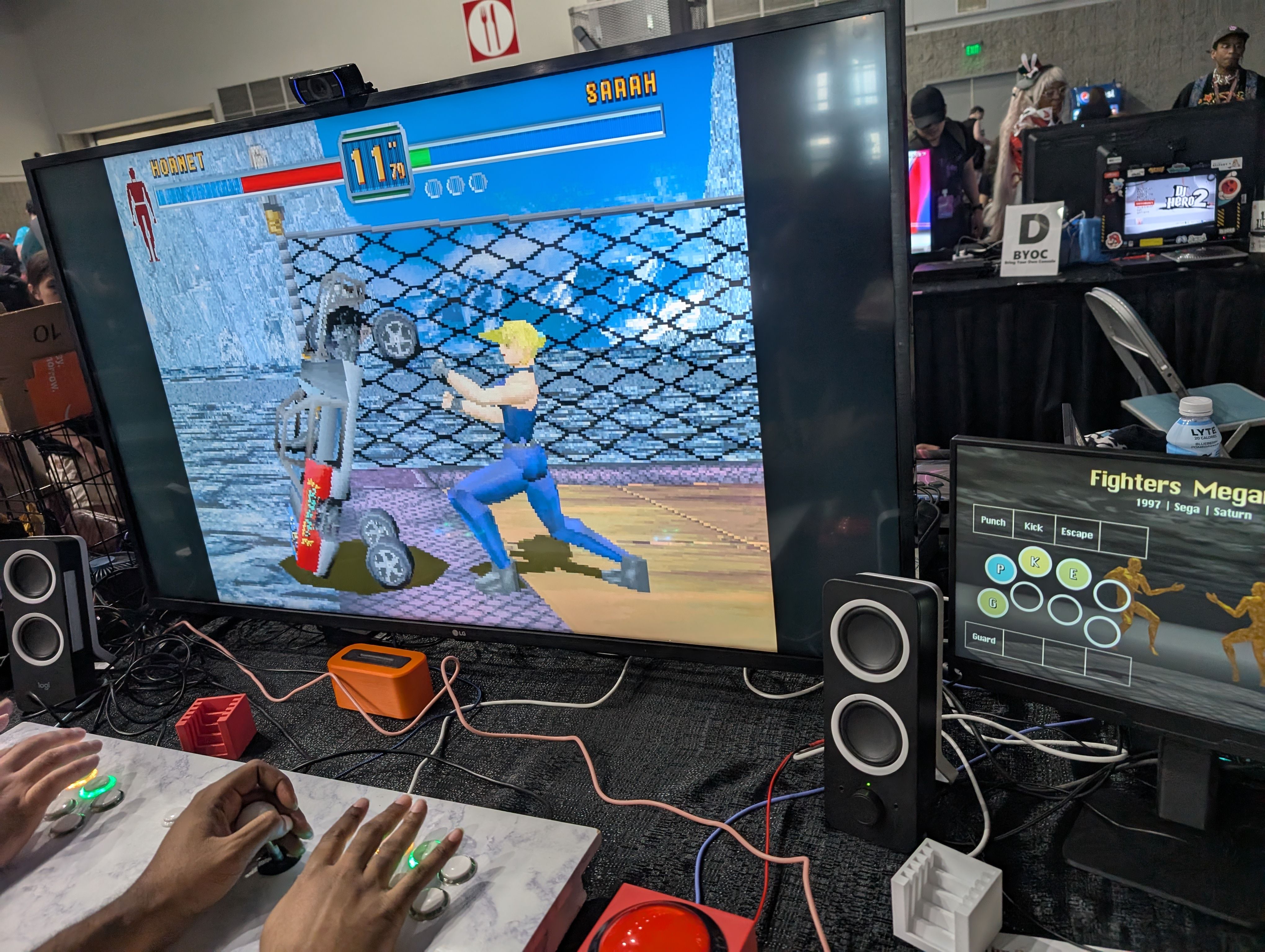
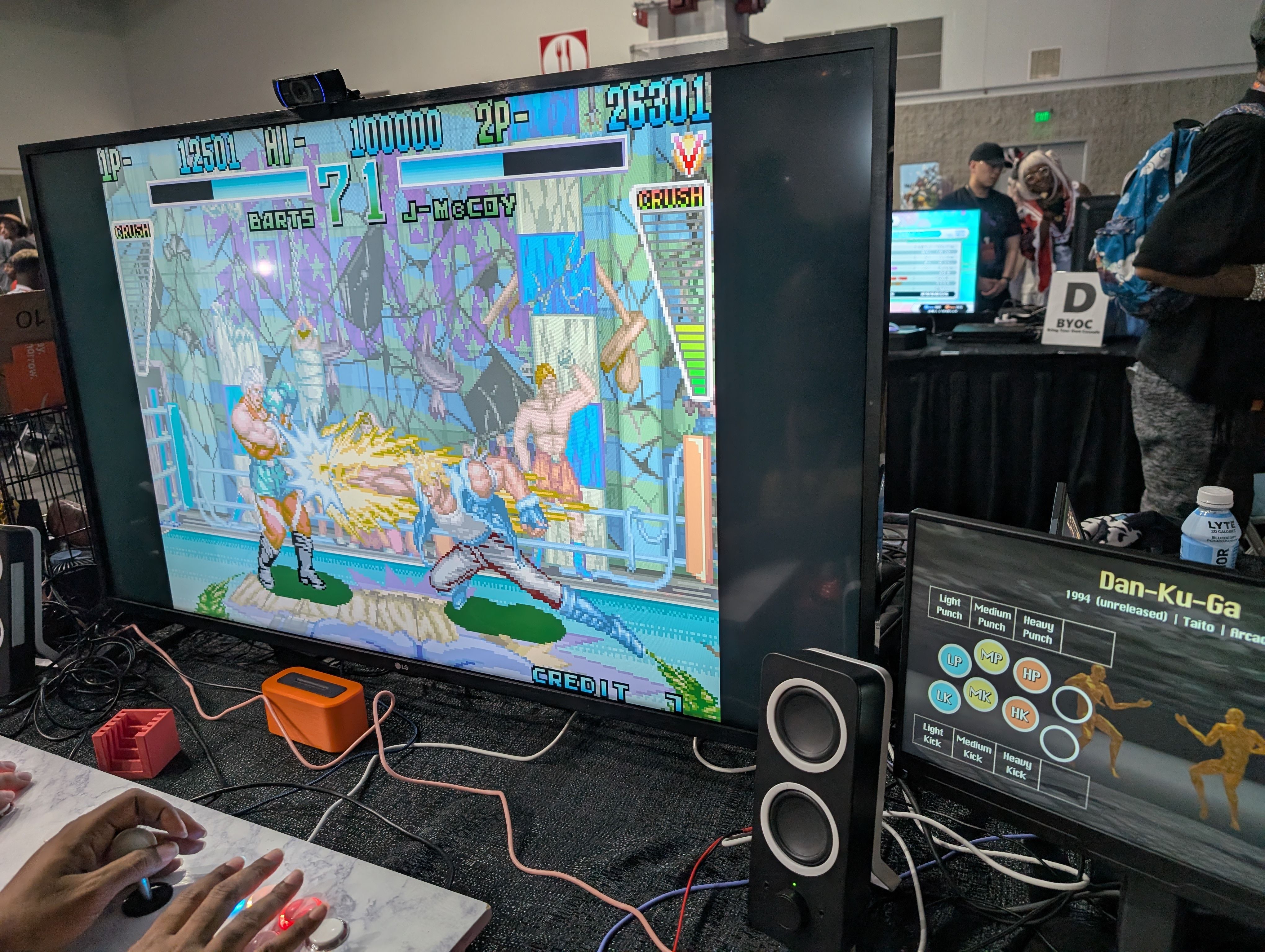
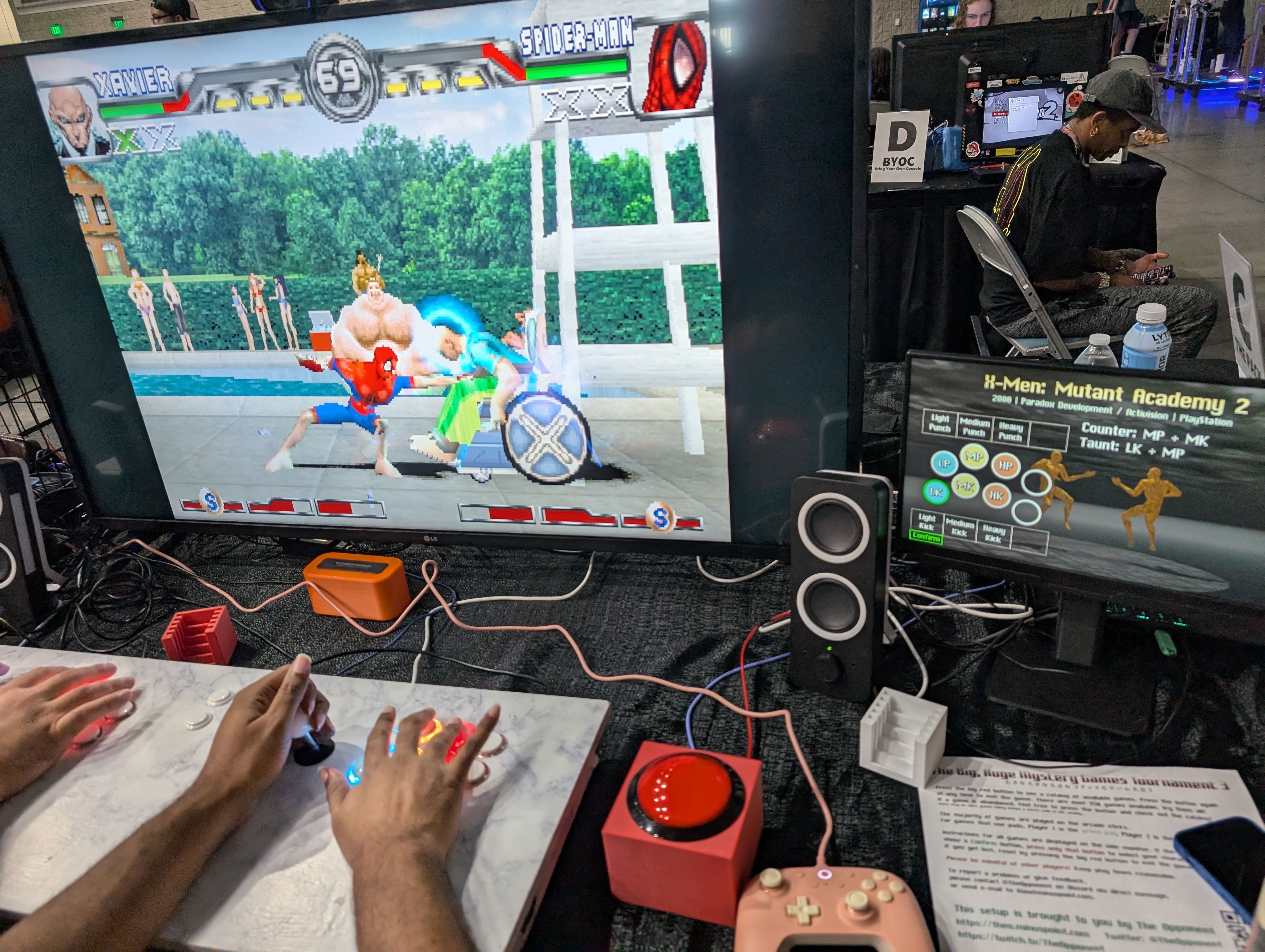
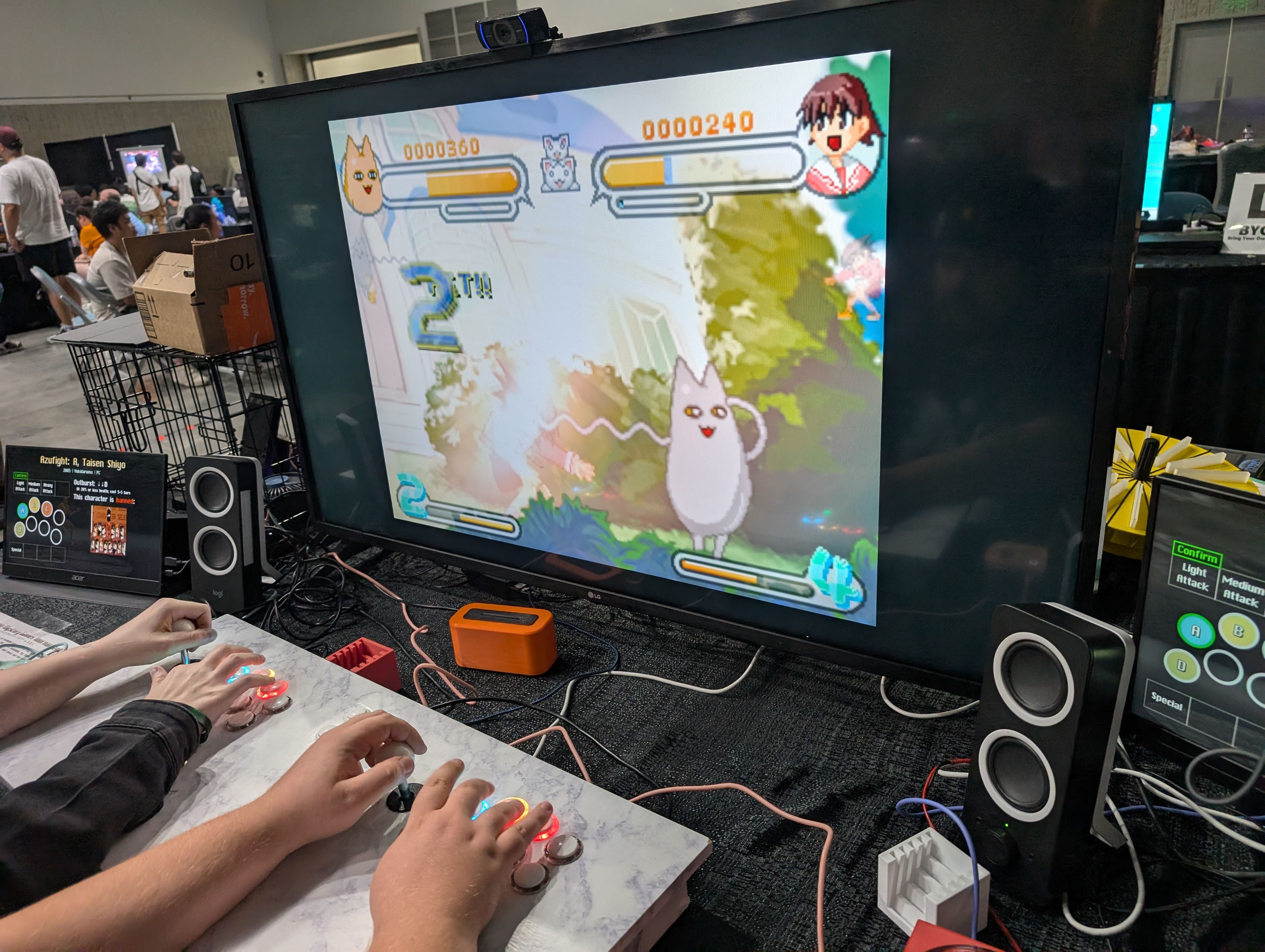
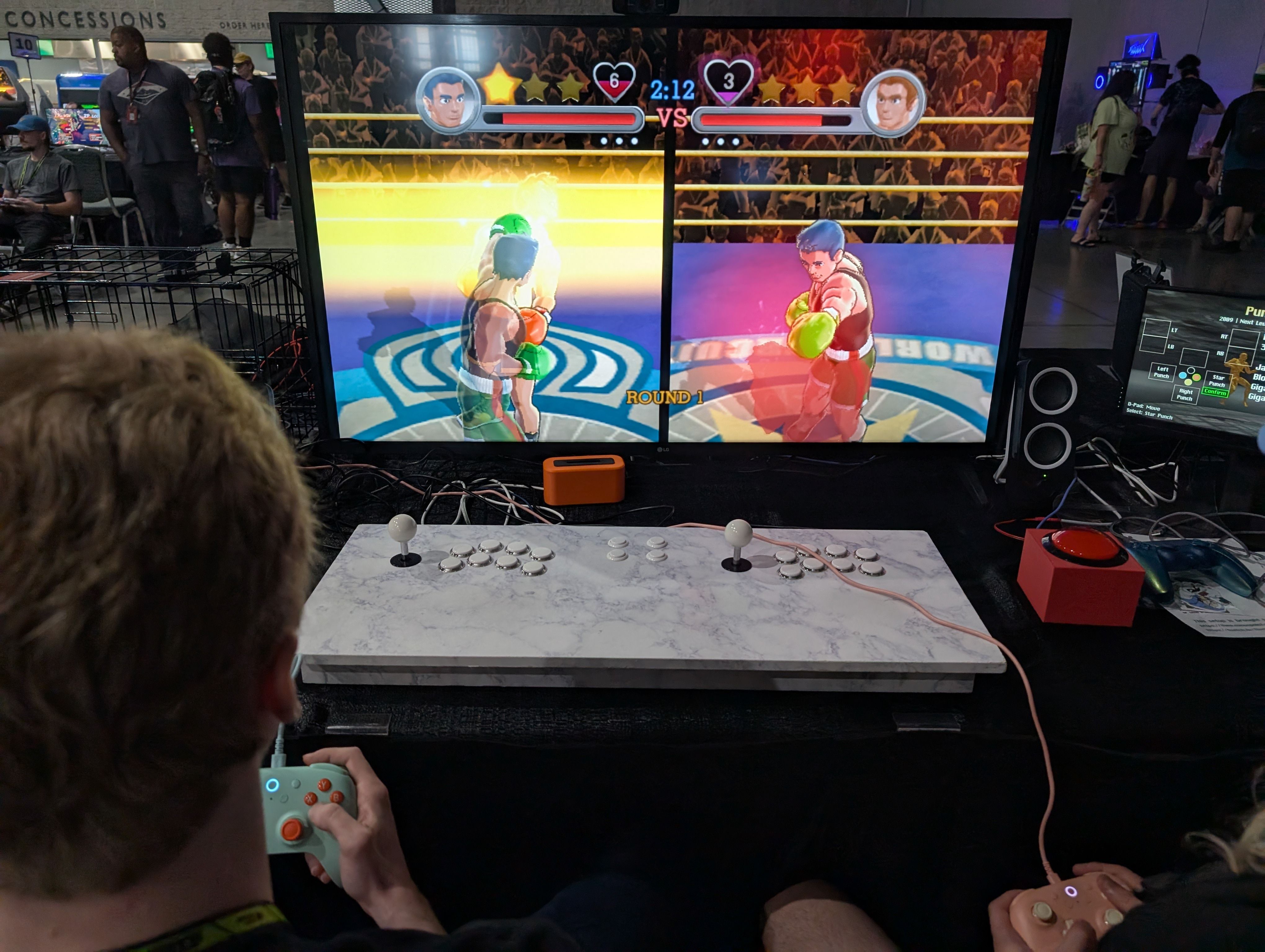
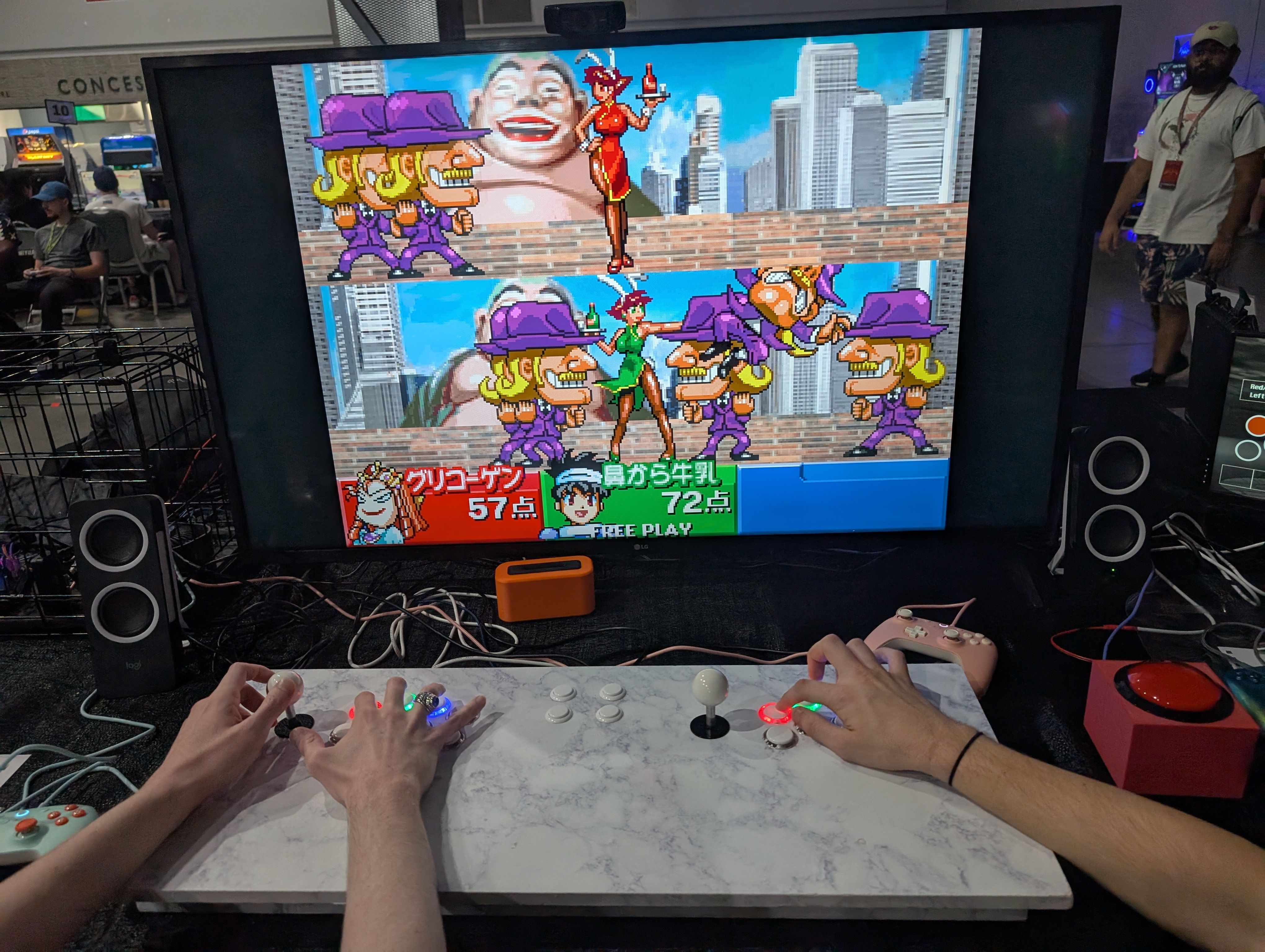
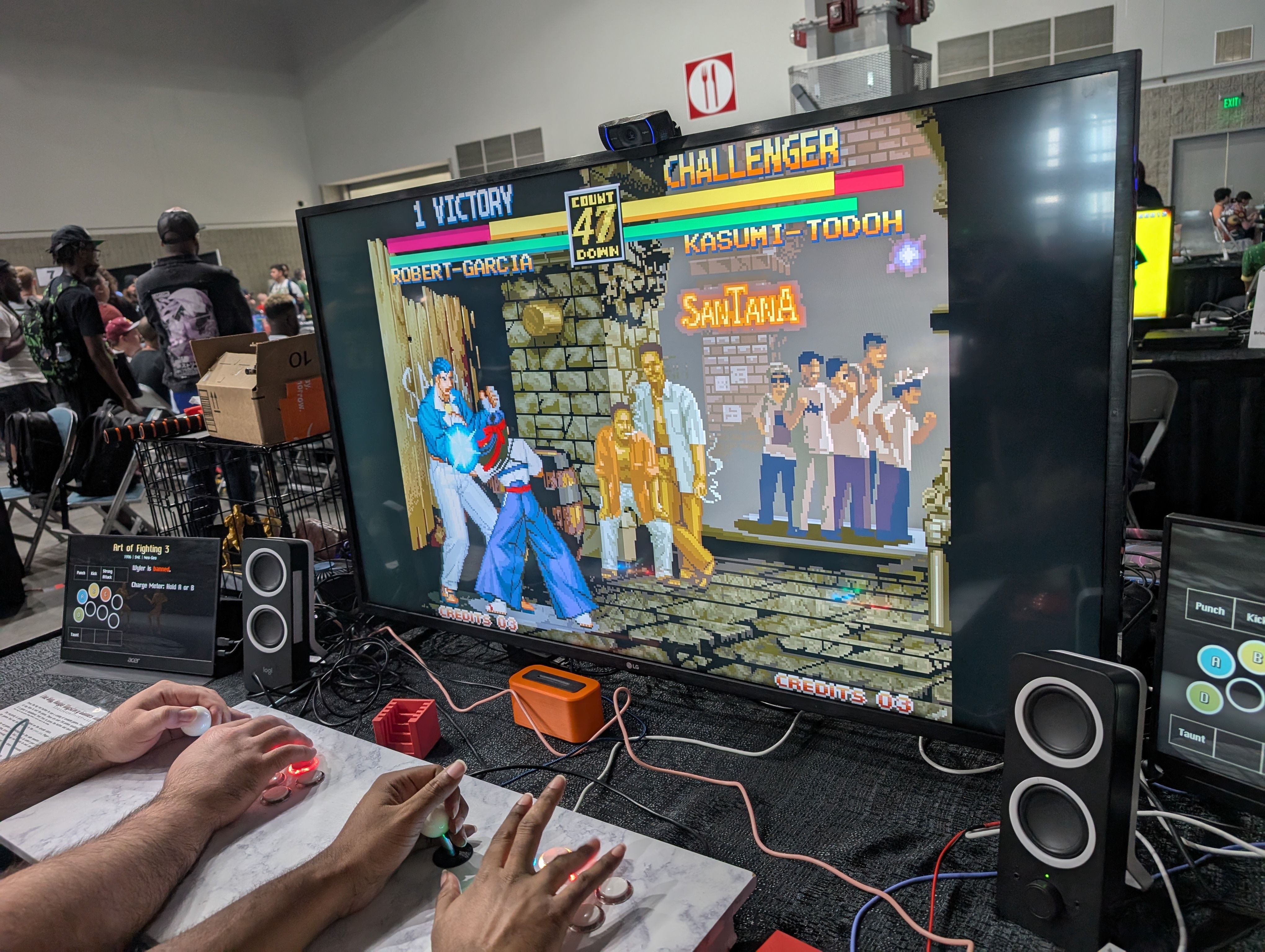
This is a selection of games played before and after the tournament. I took these photos on my phone, and was unable to use my phone during the tournament proper as I was using it as a wired mobile hotspot connected to my laptop for streaming. Many people throughout the weekend approached me to ask about this setup and whether I built it myself. I constructed the IMB2 arcade controls and engineered the game launch flow, and it got a tremendous response from all who played on it. The colored buttons show through in some of these photos beneath the players' hands.
The Tournament
One of the highest priorities of this tournament was to ensure a video record was made that can be used to pitch my service to other gaming events. I was able to stream and capture the tournament footage on my personal Twitch channel at twitch.tv/TheOpponent using my phone as a mobile hotspot, with a single webcam showing the players. However, I spread myself thin throughout the weekend, and I had multiple responsibilities on Saturday, the day of the tournament. I had hoped to use the microphone built into the webcam to get audio of the crowd and/or the players, and it failed to capture any usable audio. Even then, the tournament was located next to multiple dance game tournaments running at the same time, so it wasn't likely I would have gotten good crowd noise anyway. I also didn't have a microphone available for my own commentary, as the microphone on my laptop was disabled at the BIOS level for privacy reasons. The video at the top of this article is the only one I could find that had any kind of crowd noise. That video is also the only one that shows the entire flow of game selection, including spinning the wheel, the submonitors on either side of the TV changing to the game's instruction sheet, and the arcade buttons lighting up to match.
On July 20, I watched the recorded stream on Twitch to provide post-commentary, embedded above. Several minutes of downtime were edited out of the raw footage and player names and scores added in an overlay. The commentary on this stream was largely a candid post-mortem of the experience running the tournament. It admittedly wasn't a flawless experience for the players due to some errors on my part.
The tournament was single elimination with 32 players signed up. 24 players checked in, with one walk-up substitute for a no-show. The tournament was scheduled to begin at 6:00 PM EDT, but because some players were registered in multiple tournaments running at the same time slot, I chose to give time for late players to check in. As a result, the first round started at 6:15 PM. 58 games were played in the tournament, the largest amount of games yet, with no players taking advantage of the offer to replay the first game they lose in a matchup. The YouTube video above has timestamps for each game in the description.
Game List
- The Last Blade 2
- The King of Fighters XI
- Tatsunoko vs. Capcom: Ultimate All-Stars
- Fighter's History Dynamite (Karnov's Revenge Revolution hack )
- Teenage Mutant Ninja Turtles: Tournament Fighters (Grandmasters Edition hack)
- Aggressors of Dark Kombat
- Virtua Fighter 2 (Saturn)
- Battle K-Road
- Zero Divide 2
- Breakers Revenge
- Guilty Gear XX Slash
- Psychic Force 2012
- Tekken 5: Dark Resurrection
- Dead or Alive (PS1)
- Battle Tryst
- Super Street Fighter II Turbo (New Legacy hack)
- Astra Superstars
- DOA2 Hardcore (PS2, Japan version)
- Hinokakera Chaotic Eclipse
- Samurai Kirby
- Killer Instinct 2
- Dengeki Bunko: Fighting Ignition Climax
- Boxing (Atari 2600)
- Evil Zone
- Night Warriors
- Bloody Roar Extreme
- Tokimeki Memorial Taisen Puzzle-dama
- Battle Monsters
- Solitary Fighter
- Space Invaders: The Original Game
- Advanced VG 2
- 1 on 1 Government
- Warpath: Jurassic Park
- Big Bang Beat -Revolve-
- Ultimate Fighting Championship
- Soul Calibur II (Extra VS, Charade Mirror)
- Inuyasha - A Feudal Fairy Tale
- Top Ranking Stars
- Sonic the Fighters
- The Karate Tournament
- Toy Fighter
- The Battle of Yu Yu Hakusho
- Fatal Fury: Wild Ambition
- Street Fighter II' Special Champion Edition (Hyper speed 10)
- Pokémon Close Combat
- Alien Challenge
- Street Fighter III: 3rd Strike (Makoto Mirror)
- Ultra Fight da Kyanta 2
Semi-finals
- Revengers of Vengeance
- Agress
- WeaponLord
- Battlecry
- Street Fighter II (Super Game Boy)
Grand Finals
- Puchi Carat
- Garouden Breakblow - Fist or Twist
- Glove on Fight 2
- Virtua Fighter 10th Anniversary
- Fighting Layer
As with the previous tournament, I gave the Semi-finals round nothing but black cards, my most difficult game selections. The cards all look identical, so I have no knowledge of which cards contain which games as I shuffle them into the wheel. As I didn't have a Loser's Finals round in this tournament, it was the closest equivalent to the penultimate stage where I would give the players who reached this point the greatest challenge I could offer (and I wasn't even able to call them losers for getting that far).
Battle Tryst runs on Konami M2 arcade hardware, which was unplayable on MAME for many years. Several weeks before The Beast In The East, a new custom fork by Tovarichtch was released as a preview build that overhauls the driver and makes the games on that hardware playable at full speed, or close to it on mid-range hardware like the Beelink SER5 I use. I took a risk in including it despite little time to give it proper testing, because another primary goal of the tournaments is to expose little-known games to a new audience, and a Konami game released in 1998 and only playable for a worldwide audience for the first time less than a month ago is a prime example of that, especially since there were no guides written for it at the time.
Related to that, I like to include notable ROM hacks and less-played versions of popular games in the opening round of the tournament where the audience is the largest. I want to give exposure to extensive efforts to rebalance and bugfix games with smaller but dedicated scenes, and including unfamiliar builds of the most popular games is meant to challenge players familiar with the most-played versions with incompatible muscle memory. Some of the most comprehensive hacks also change movesets and simplify the most complex inputs, so everyone gets some degree of resistance early on regardless of their skill level.
Two games had to be skipped due to technical issues: Idol Showdown failed to recognize one of the controller sides, and the PC port of Guilty Gear Isuka failed to launch. Idol Showdown was fixed after the tournament by enabling Steam Input (I suspect an update between the time I tested it and tournament day was the cause of the sudden controller incompatibility), but I was not able to diagnose what kept Guilty Gear Isuka from starting. I should be able to use Idol Showdown in the next tournament, but I may need to resort to the arcade version of Guilty Gear Isuka if I include that as well.
I was guaranteed a three hour block by the staff for this tournament, but even after the many measures I took to maximize player turnaround, it ended at 9:20 PM EDT. After deleting downtime between matches searching for the next players, the tournament video was just below three hours in length. Had I chosen to enforce the starting time of 6:00 PM, I may have been able to end at exactly 9:00 PM. Because of the time considerations from some players failing to appear in a timely manner and some games unexpectedly taking a long time to resolve, I did not use the boss cards which contain longer games. I use those cards for Winner's Finals in double elimination, but there's no true equivalent to it in single elimination. For the same reason, I changed Semi-finals from first-to-3 to first-to-2 (I explained to the players before the tournament started that this may happen depending on remaining time), and only added one black card to the wheel after round 1 (which was never rolled) and not continuously unlike the last tournament.
Finally, for Grand Finals I allow the finalists to freely choose from all unplayed games, but in a first for my tournaments, they both insisted that the last games are also randomly chosen. For this, I selected five final games and randomized their order. There was one caveat to this: One of the final games was a black card, and it came up in game 5. The game was Oshidashi Zintrick, a somewhat obtuse puzzle game for Neo-Geo CD. I made an executive decision to abort that game immediately, as I felt it would not have been a satisfying conclusion to a mystery tournament. The final game was instead Fighting Layer, a much more fitting end game. There was a cabinet running that game in on the venue floor last year, but it didn't return this year.
Future Challenges
One of my greatest concerns is tournament length. The last thing I want to do is bore the audience by making it run for longer than advertised. The games I run have widely varying average lengths, between 1-5 minutes depending on genre and how many rounds they last. I always get nervous when the latter happens, because I fear that the audience can become disengaged or leave. When I attend mystery tournaments myself, that's what I feel when something runs past the point I'm interested in it. This is an unavoidable reality of my format of randomly selected games, so I decided to make it a feature of my tournaments: the game selection is designed to keep the players on unstable footing, and indeed there were multiple matchups where a 30-second game immediately followed one that lasted several minutes.
Between the previous tournament and this one, I got feedback asking for more non-fighting games. I prepared several dozen such games, most of which are competitive puzzle games. I intended to add them after round 1, but I second-guessed myself and hesitated on adding most of them to the bracket. The advice I read for running mystery game tournaments is to open with reputable, reliable choices for fighting games and then gradually add more unfamiliar and non-fighting games as the bracket goes on, but I decided to keep to mostly safe choices, as I was constantly watching the time and tried to keep to my scheduled block with so many players. I believe I can address this and be more ambitious with game selections by imposing a smaller cap for entries. I allowed up to 32 signups, which was reached on the first day of the event, but reducing to 16 will allow running double elimination, which means the competitors will play more games, and keeping the same 3-hour block will allow for more long games. One of the concerns I had with single elimination is that I felt like I had to use safe choices for round 1, because I wouldn't want any players who got eliminated in the first round to have played for less than two minutes because a game could end faster than the average fighting game match. Double elimination guarantees the competitors will play a minimum of four games, so I could be more ambitious with game selection in every phase.
I failed to get any audio from the crowd and players for this tournament, so the commentary I recorded on Twitch after the fact is intended as a substitute. The proper solution for all of the issues related to audio is to bring redundant equipment, including more microphones and webcams, and possibly hire a small staff to manage other aspects of the tournament such as the bracket so I can focus on interacting with the crowd and the stream chat. If I were to mic the players, it would be between the arcade controls and the TV, and that would cause an obstruction. I would need to elevate the TV six inches or more off the table to keep the microphone away from the screen.
Of the positive feedback I've received for the setup, one commenter noted it was scalable compared to the mystery tournament setups seen at Combo Breaker, since the PC and the controllers are in a single self-contained setup and not using real console hardware and hard copies of individual games. Combo Breaker's mystery tournament is many orders of magnitude above my own in scale and budget, with a large number of stations and copies of games with a full paid staff managing them, enabling them to run pools and host a far larger number of participants. I'm a single individual running emulators and Steam games with homemade arcade controls built and funded by myself. Rebuilding the entire setup at current market prices for PC parts, lumber, and arcade components will approach $1,000 USD, to say nothing of the labor of recreating the IMB2. If I should be able to duplicate the setup, I would be able to run pools myself, or perhaps a mystery tournament spanning multiple days.
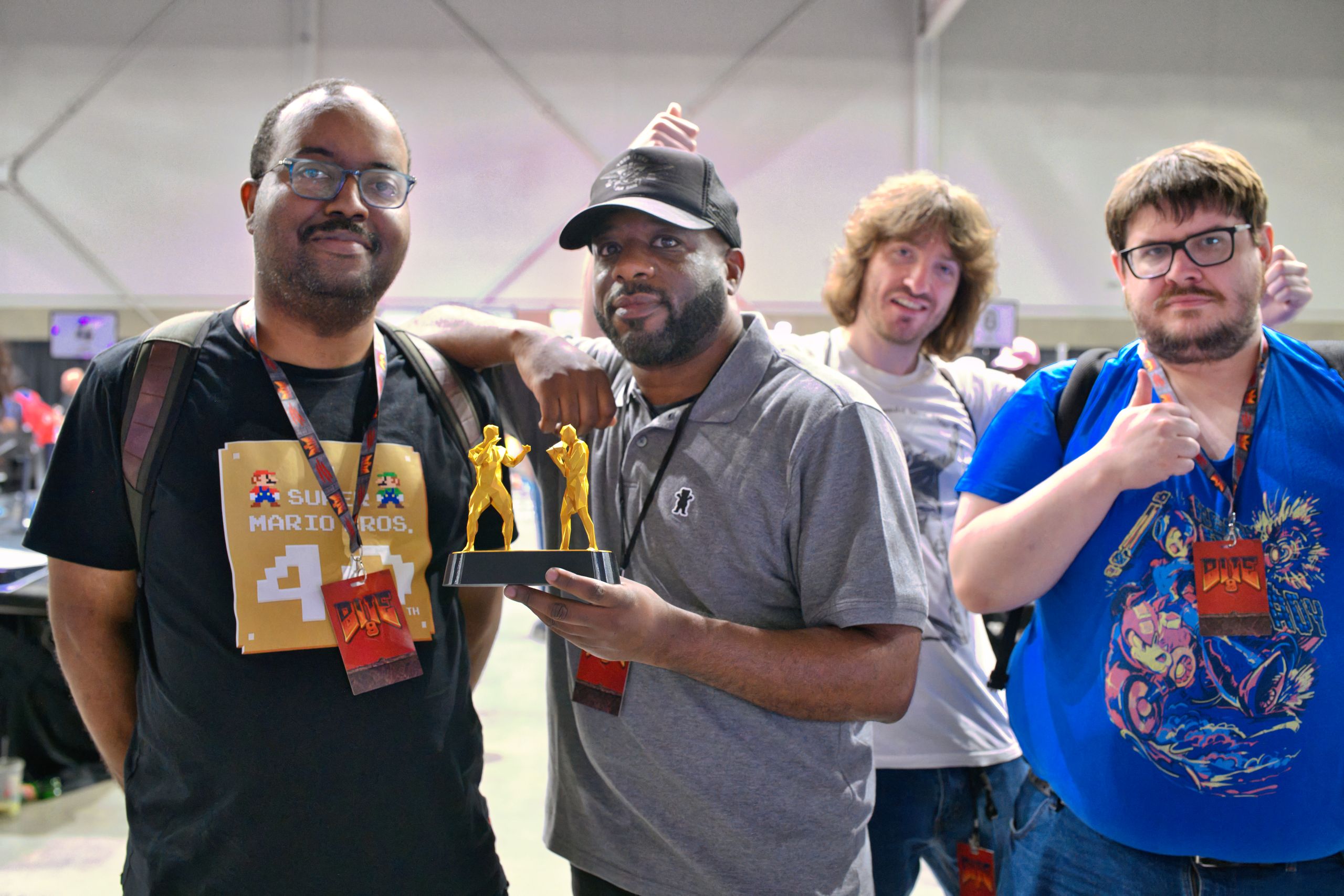
I put a great amount of time and money over the previous two months to prepare for this event, the first tournament I held for The Beast In The East in years, and I feel I've done everything I could to make the tournament thrilling and unpredictable for the players and spectators, all for the purpose of showcasing my services for any event coordinators who might read this post. My light-up arcade controls, instructions submonitor, and game selection turned a lot of heads throughout the weekend too. I did have to service the setup several times, but no more than the amount of time I expected to. Looking back at what went right and wrong, I think I would have made fewer errors if I didn't take on so much responsibility during the weekend. The bulk of the preparation work (augmenting the hardware and writing scripts for and researching 400 games) is already done, so I won't need to devote so much of my spare time preparing for future events again. The setup has proven reliable enough to run unattended for most of the weekend, so I would like to be able to spend more time enjoying other games on the floor rather than supervise my equipment.
If reading this post and watching the tournament archive made you interested in commissioning me to run this tournament at your own event, contact me at the e-mail address at the bottom of this page. Be prepared to answer questions on the size and operating hours of the venue, the availability of displays, tables, and projectors, and how many players you expect will register.