- Tue 28 April 2026
- Personal
This is the first and only time I'm getting this off my chest. A few days ago, I woke up and arbitrarily decided I'm through with Sakura Wars as a whole and making excuses for Sega and the fandom. Today, I finally realized why.
The Japanese version of the most recent Sakura Wars game was released on December 12, 2019. The English version was released to moderate fanfare six years ago on this day. Since then, Sega has demonstrated a breathtaking and deliberate lack of commitment toward nurturing the fanbase of Sakura Wars, domestically and abroad. I don't know if the severe underperformance of this game (and Sakura Revolution) caused it or was due to it, but it doesn't matter. There have been followups to this game in the form of a canonical anime sequel that introduces new major characters, and stage shows, but none of them have converted into new games or even interest within Sega in re-releasing older ones, not even exclusively for the Japanese audience.
Sega announced yet another initiative to acknowledge the existence of their older properties, yet in the last five years, they have shown disdain for the notion of advancing anything of theirs that isn't Like A Dragon, Sonic the Hedgehog, or Persona. After a decade of these retro celebration deals doing pretty much nothing to the status quo, I have zero faith that this one will be any different. I don't care that the promotional image they showed includes Sakura Wars because I know that's the only lip service it's getting. Sega is one of the worst companies today about keeping their old properties relevant for modern audiences, largely because they insist on keeping all of it to themselves and, unlike Nintendo, has no platforms of their own to ensure whatever they do decide to re-release remains available for an extended period. Twice now they mass delisted a huge portion of emulation products on multiple platforms in the name of unifying them, and the replacement products, if they got any, are generally regarded as inferior to what came before.
Sega found great success in Like A Dragon and it's come at the cost of almost everything else they do. Related to Sega's back catalog: It twists a knife in me to see someone talk up a newly emulated arcade game that's locked behind the newest Like A Dragon game, and as I mentioned in the post, they only ever get praised for doing what exA-Arcadia is savaged for doing: reviving an old cult favorite and ensuring only people who buy into their ecosystem ever get a chance to enjoy it. This is the same behavior that private collectors who buy up rare ROMs and prototypes to ensure they're kept out of the hands of the public call "media preservation". They clearly have the resources to release these games individually at a premium price and people will be happy to pay 1/5 the price of a new Like A Dragon game for the convenience of a dedicated release, but this kind of targeted release they're doing now is benefitting the wrong people.
I personally hold Like A Dragon culpable for all of the problems of the present-day Sega, because it boggles the mind that in this decade alone, eight games in that franchise have been released. How many other Sega franchises got that many games so quickly? How is it that fans of retro arcade games cry bloody murder when ROMs are hoarded by private collectors or exA-Arcadia announces a new version of an older game at the expense of the emulation community, yet praise Sega highly when they do exactly the same thing by price-gating their own arcade games behind much more expensive games? The single biggest victim of this is Virtua Fighter. The re-released versions of Virtua Fighter 5 have all been the work of the same valor-stealing sycophants that call themselves RGG Studio. Apparently the former AM2 has been subsumed by RGG Studio in much the same way Activision has done with many smaller studios to continue building up Call of Duty, and for some reason everyone is fine with this. I will never understand why.
It's already been pointed out how with their respective 2019/20 games, Like A Dragon and Sakura Wars traded their real-time and turn-based battle systems with each other. The former is one of the best selling Like A Dragon games and the latter is the worst selling Sakura Wars game. Much like Valkyria Chronicles before it, Like A Dragon took mechanics from Sakura Wars to find great international success, and gave back nothing in return. All of this isn't even going into how detestable I find Like A Dragon as a game series and everything it stands for. Sega makes it clear where their finite resources are being prioritized and it isn't anything I enjoy.
This is hardly the first time a long-running series has been left in the cold, and not even the worst case. As I write this, I keep in mind fans of even longer-running franchises that have been neglected even harder by the likes of Nintendo, Capcom, Konami, Namco, and so many other companies, and all of them have better track records than Sega for keeping some portion of their older library available for modern platforms. As mentioned above, Sega has been unusually antagonistic about ensuring many of their older games are available for sale compared to most other Japanese studios. Sakura Wars is a unique case in all of this in that Sega's English-language branches sometimes post about them and talk them up very briefly, and then don't actually follow through with any releases. It was a very big deal for Sega for a long time and a lot of people worldwide knew it for years. Sega of America failed to capitalize it until well after it was too late. NIS America had to be the one to pick up the pieces five years after the release of So Long, My Love and the English fan community only grudgingly accepts the results. They don't even use the names they changed anymore. Incidentally, the first Yakuza game was released the same year as So Long, My Love.
I've always been of the opinion that companies should not be pressured into making new releases to coincide with anniversaries because we've seen what happens when they do, especially when Sega was suckered into doing exactly that for Sonic 2006. In this case though, I am not waiting until September 27, 2026 for Sega to do nothing on the 30th anniversary of Sakura Wars. They've already done this on September 27, 2021 for the 25th anniversary, and pretending they will do anything else five years on is nothing less than an insult. Sega had countless chances to reach out to the portion of the fanbase that wants to get these games in the hands of more people, which includes translators, collectors, and even ROM hackers like myself. That approach has proven highly successful for other localization houses over the years and there is zero reason Sega can't do the same for a series they have no time to localize themselves.
The most influential people keeping it relevant are the remaining voice cast of the original games doing stage performances whenever they can, without Sega's involvement or support. Multiple major actresses have passed away in the last five years, and those still living can only keep it up for so long.
After everything I personally invested as a fan over the last decade and a half, there's just no upside for me anymore. The length of this screed is proof that holding out any longer is hazardous for my health. I've witnessed one too many episodes of fandom-related and translation-related drama to continue. I won't go into details except that I already have severe trust issues with larger groups in multiple fields and I need to put all of this behind me as fast as possible, before my family history of heart failure decides that for me. There's nothing left but to quit before what little trust I have left is eroded even more.
It might sound like I'm exaggerating this, and I didn't really get into it in the post, but even I recognize I have no one except myself to blame for this. I'm the one choosing to make this a problem by seeing it as them deprioritizing what I like in favor of what I don't like. But the situation has changed. I'm at a time in my life where personal health is a real concern for me and I have to cut away stressors wherever I can. It's becoming increasingly difficult to engage with this series without thinking about what's being lost in exchange. I have a severe personal issue when others talk up a popular work I do not like, because it always comes at the expense of that which I do like and is unpopular. It's an effort to not riposte with my disapproval of the work, because I know from experience that it always starts a conversation I do not want to have. Being a non-Japanese fan of Sakura Wars means having to also endure indifference from a company that also creates much more popular franchises, and since those include franchises I cannot stand, I no longer have it in me. They could release a complete translated anthology of every main game tomorrow and it will be too little, too late. It's a lose-lose situation: Sega has made it clear that they don't love all of their own properties equally, and the ones they do love are the ones I hate the most but everyone else on the planet loves the most. Sonic Racing CrossWorlds doesn't care to even hint that Sakura Wars exists, let alone has been around longer than most of the characters in that game. Why should I continue to invest myself into Sakura Wars when Sega themselves is against it?
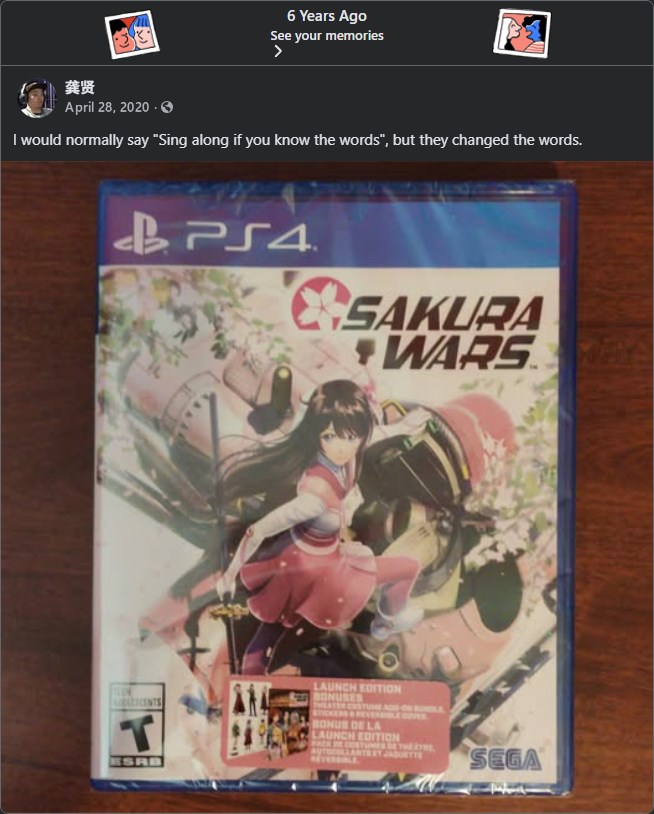
For anyone concerned with any ongoing translation efforts, this post does not constitute withdrawing from any of them. All of my research and contributions will remain available indefinitely, as I have dedicated them to the public domain for exactly such a circumstance. If I should have to permanently retire from fan translation, I will cite health reasons as the primary cause. One of the factors that spurred this post is witnessing one too many episodes of fan translation drama in the last six months. I've been burned one too many times by thinking I could trust my friends not to get embroiled in interpersonal conflict. I don't need any more of that when I have had more than my share of such politics in my professional localization career, to say nothing of what I endure at home.
Update April 30, 2026: Sega did not make any posts on the sixth anniversary of the newest Sakura Wars game, which shouldn't come as a surprise. They did release something else the day after, and it speaks for itself.